Sexual health concerns are incredibly common—but they’re also widely misunderstood, under-discussed, and often dismissed.
Many women experience challenges related to pain, desire, arousal, or orgasm at some point in their lives. Yet, they’re often left wondering:
Is this normal?
Is something wrong with me?
Who do I even talk to about this?
The reality is this:
Most sexual concerns are treatable with the right combination of medical care, education, and therapeutic support.
To help make this clearer, I created a clinical flowchart (below) that breaks down common sexual health concerns, how they’re understood clinically, and what next steps may look like.
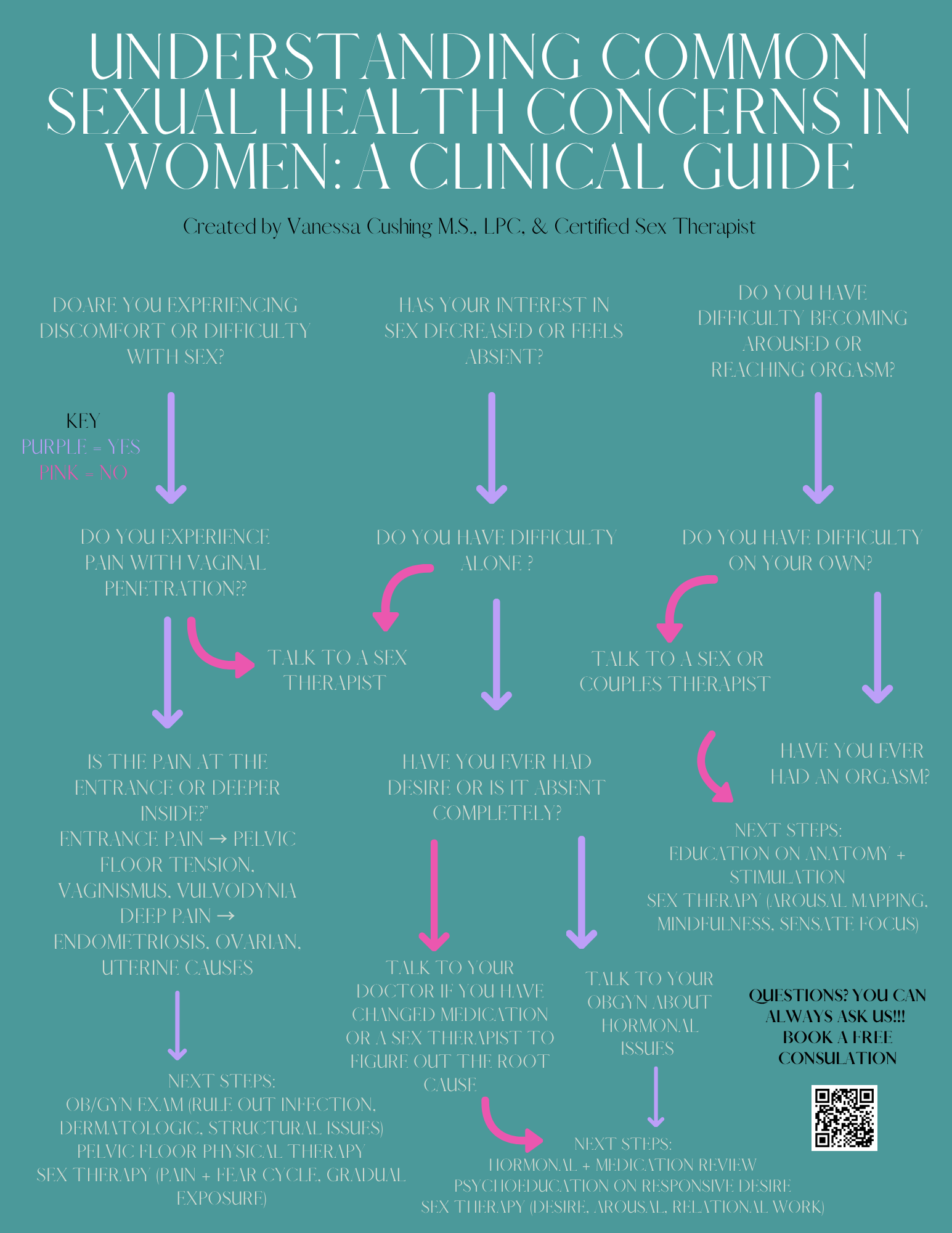
Breaking It Down: What the Flowchart Shows
This guide focuses on three of the most common areas of concern:
1. Pain During Sex
If you experience pain with vaginal penetration, you are not alone—and this is never something you should have to “push through.”
Pain can show up in different ways:
At the entrance → often related to pelvic floor tension, vaginismus, or vulvar pain conditions
Deeper inside → may be associated with conditions like endometriosis or other internal factors
What to do:
Start with an OB/GYN evaluation to rule out medical causes
Consider pelvic floor physical therapy
Work with a sex therapist to address the pain–fear cycle and rebuild comfort and trust in your body
2. Low or Absent Sexual Desire
Changes in sexual desire are one of the most common concerns I see in my practice.
But here’s something many people don’t realize:
Not all desire is spontaneous.
For many women, desire is responsive, meaning it develops after arousal begins—not before.
Low desire can be influenced by:
Hormonal changes (postpartum, menopause, contraception)
Stress, burnout, and mental load
Relationship dynamics
Medication side effects (especially SSRIs)
What to do:
Talk with your doctor about hormones or medication changes
Learn how your desire actually works (this alone can be transformative)
Work with a sex therapist to explore arousal, emotional connection, and relational factors
3. Difficulty with Arousal or Orgasm
Some women struggle with becoming physically aroused or reaching orgasm, even when they want to.
A helpful question is:
Have you ever been able to orgasm before?
If no → this may be a primary concern (often linked to lack of education or experience)
If yes, but not anymore → this may be influenced by stress, hormonal shifts, or psychological factors
Common contributing factors include:
Limited knowledge of anatomy or stimulation
Anxiety or distraction during sex
Past experiences or trauma
Hormonal changes
What to do:
Learn about your body and what kind of stimulation works for you
Reduce pressure and performance expectations
Engage in structured exercises (like sensate focus or arousal mapping) with professional support
Why This Matters
Too often, sexual health is treated as either:
purely medical
orpurely psychological
In reality, it’s almost always both.
That’s why the most effective approach includes:
Medical evaluation when needed
Education about how sexual response actually works
Therapeutic support to address emotional, cognitive, and relational factors
You’re Not Broken and You’re Not Alone
If you’re experiencing any of the concerns in this guide, it doesn’t mean something is “wrong” with you.
It means your body and mind are responding to something—and with the right support, those patterns can change.
How we Can Help
At Cushing Counseling, we provide evidence-based sex therapy to help individuals and couples:
Reduce pain and rebuild comfort with intimacy
Understand and reconnect with desire
Improve arousal and orgasm
Navigate relationship and communication challenges