“We don’t have time to have sex”

One of the most common conversations we have in sex therapy has nothing to do with technique. It has nothing to do with desire disorders, trauma, or relationship breakdown. It is a conversation about expectations — specifically, the gap between what people believe sex is supposed to look like and what it actually looks like in real human bodies and real human relationships.
That gap causes an enormous amount of unnecessary suffering.
People come into therapy convinced that something is wrong with them because sex does not last as long as they think it should. Or because desire does not show up the way they expected. Or because their experience does not match what they have seen, heard, or absorbed from culture over decades of messaging about what “good sex” looks like.
In many of these cases, nothing is wrong. The expectation is wrong.
This post is about one of the most persistent and damaging of those expectations: how long sex should last.
What does research actually say about sexual duration?
Let’s start with the numbers, because they tend to be genuinely surprising to most people.
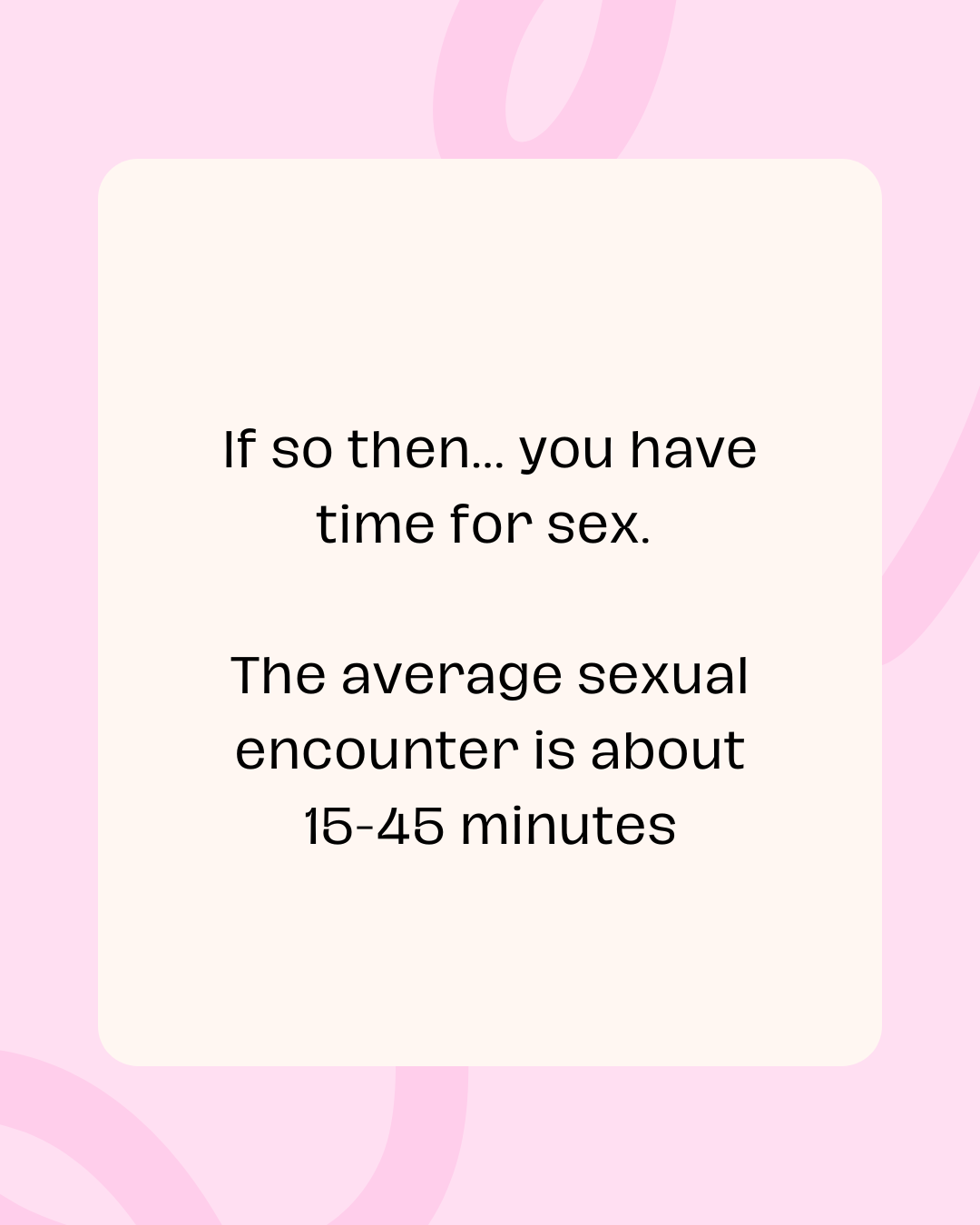
Research on sexual duration consistently finds that the average complete sexual encounter — from beginning to end, including all forms of activity — lasts somewhere between 15 and 45 minutes. Within that, the portion involving penetrative intercourse specifically is substantially shorter. Multiple studies place the average duration of intercourse itself at between 3 and 9 minutes.
That is not a sign of dysfunction. That is the data on how actual human beings, in actual relationships, actually have sex.
3–9 min
average duration of penetrative intercourse in research studies

15–45 min
average duration of a complete sexual encounter
Compare that to the standard most people are quietly measuring themselves against — one shaped by pornography, romantic comedies, locker room mythology, and a general cultural silence about what sex is actually like — and you begin to understand why so many people walk around convinced that they are somehow failing at sex.
They are not failing. They are human.
The research does not support the idea that longer sex is better sex. What it does support is that mutual satisfaction, emotional connection, and absence of pressure are the factors most consistently associated with sexual wellbeing.
Where do unrealistic expectations come from?
Unrealistic sexual expectations do not appear from nowhere. They are learned — from multiple sources, over a long period of time, often before we have any real sexual experience to compare them against.
Pornography
Pornography is probably the most obvious and most significant contributor to distorted sexual expectations in contemporary culture. Pornographic content is edited, performed, and produced for a specific audience response. It is not documentary footage of typical human sexuality. Duration, stamina, body type, response, and virtually every other dimension of what is depicted are not representative of real sexual experience.
This would be a manageable problem if people understood it clearly. The issue is that for many people — particularly those who encountered pornography before having much real sexual experience — it functions as sex education by default. The template it creates is difficult to dislodge even when people intellectually know better.
Cultural and media messaging
Film, television, and popular culture present a version of sex that is consistently dramatic, effortlessly passionate, and apparently endless. Nobody in the movies has an awkward moment, loses arousal at an inconvenient moment, or finishes in three minutes. The implicit standard these depictions create is one that real human beings cannot consistently meet — and were never supposed to.
Social silence
Ironically, the cultural obsession with sex coexists with an almost complete absence of honest conversation about what it is actually like. People rarely talk openly about their real sexual experiences — the unremarkable encounters, the variability, the nights when it is perfunctory and the nights when it is genuinely connecting. The silence leaves the distorted public images to fill the gap.
Previous relationships
People also bring expectations from past relationships — either measuring a current partner against a previous one, or carrying forward conclusions from past experiences that may not generalize. A partner who consistently wanted sex for long periods of time sets an expectation that becomes the default standard, even if it was not typical or representative.
What happens when expectations do not match reality
When people measure their sex lives against an unrealistic standard, the consequences are predictable and significant.
Performance anxiety
Performance anxiety — the fear of not being good enough, lasting long enough, or responding correctly during sex — is one of the most common sexual concerns we see in both individual and couples therapy. It is almost always rooted in an implicit comparison to a standard that the person has never examined critically.
The cruel mechanics of performance anxiety are well-established: anxiety activates the sympathetic nervous system, which directly interferes with the physiological processes required for arousal and sexual response. The more anxious someone becomes about performance, the less likely they are to perform well — which generates more anxiety. Without intervention, this cycle tends to intensify over time.
Shame
When people believe they are not measuring up to a normal standard, the emotional response is often shame. Not just disappointment or frustration — shame. The sense that something is fundamentally wrong with them, that they are inadequate as a sexual partner, that their body is failing in some way it should not.
Shame is particularly corrosive because it tends to produce silence. People who feel ashamed of their sexual experience do not talk about it — which means the unrealistic standard never gets challenged, and the shame deepens.
Avoidance
A predictable response to performance anxiety and shame is avoidance. If sex has become associated with inadequacy, anxiety, and disappointment, the motivation to initiate or engage with it understandably decreases. Avoidance provides short-term relief from anxiety — and creates long-term relational and sexual problems.
Relationship strain
When one or both partners are operating under distorted expectations, the impact on the relationship extends well beyond the bedroom. The partner who finishes “too quickly” may withdraw from intimacy altogether out of shame. The partner on the receiving end may interpret that withdrawal as rejection, disinterest, or something they have done wrong. Conversations that could clarify what is actually happening do not occur because the topic is too charged.
What psychoeducation does — and why it matters
Psychoeducation is one of the foundational tools in sex therapy, and its value is often underestimated. Simply providing accurate information — about what research says about sexual duration, about how arousal and desire actually work, about the range of normal human sexual experience — frequently produces significant shifts in clients’ distress.
When someone learns that the average duration of intercourse in research studies is 3 to 9 minutes, and that their experience falls squarely within that range, a framework that has been generating shame and anxiety for years loses its foundation. The problem was never the sex. It was the standard.
Psychoeducation in sex therapy also covers:
Responsive versus spontaneous desire — and why waiting to feel “in the mood” before initiating is not how desire works for many people
The role of the nervous system in arousal — and why anxiety, stress, and self-monitoring directly interfere with sexual response
The natural variability of sexual experience across time, phases of life, relationship stages, and individual differences
The difference between sexual function and sexual satisfaction — and why they are not the same thing
What research actually says about the factors most associated with sexual wellbeing: emotional connection, communication, absence of pressure, and mutual attunement
Sex is not a performance to be evaluated against a standard. It is an experience between people — and the goal is not longer, or more impressive, or closer to what someone else said it should be. The goal is better: more connected, more present, more genuinely satisfying for everyone involved.
What “better” actually looks like
When performance pressure, shame, and unrealistic expectations are removed from the equation, something shifts. Couples who come into therapy focused on duration, technique, and whether they measure up often leave focused on something entirely different: presence, connection, communication, and genuine pleasure.
Better sex is not sex that lasts longer. It is sex that is more embodied — where both people are actually present rather than monitoring and evaluating. It is sex where desire is real rather than performed. Where communication is possible. Where variability is accepted as normal rather than treated as evidence of failure.
These are not vague aspirations. They are outcomes that sex therapy consistently helps people achieve — and they almost always start with the same thing: replacing the distorted standard with an accurate one.
When to seek support
If performance anxiety, shame around sexual duration, or the pressure to meet an unrealistic standard is affecting your sex life or your relationship, those are legitimate reasons to seek specialized support. You do not need to be in crisis. You need to be experiencing something that is getting in the way of the intimacy and connection you want.
At Cushing Counseling, psychoeducation is woven into everything we do. We help individuals and couples replace the stories they have been carrying about what sex is supposed to be with an accurate, compassionate, and evidence-based understanding of what it actually is.
We serve clients in Virginia, Florida, Maryland, and DC, and via telehealth in . Book a free 15-minute consultation at cushingcounseling.com or call (703) 544-7081.
The goal is not longer. It is better. And better is absolutely achievable.
— Vanessa Cushing, LPC, AASECT Certified Sex Therapist | Founder, Cushing Counseling